
Alexa vs Google Assistant vs Built-In AI TV Voice Control Compared
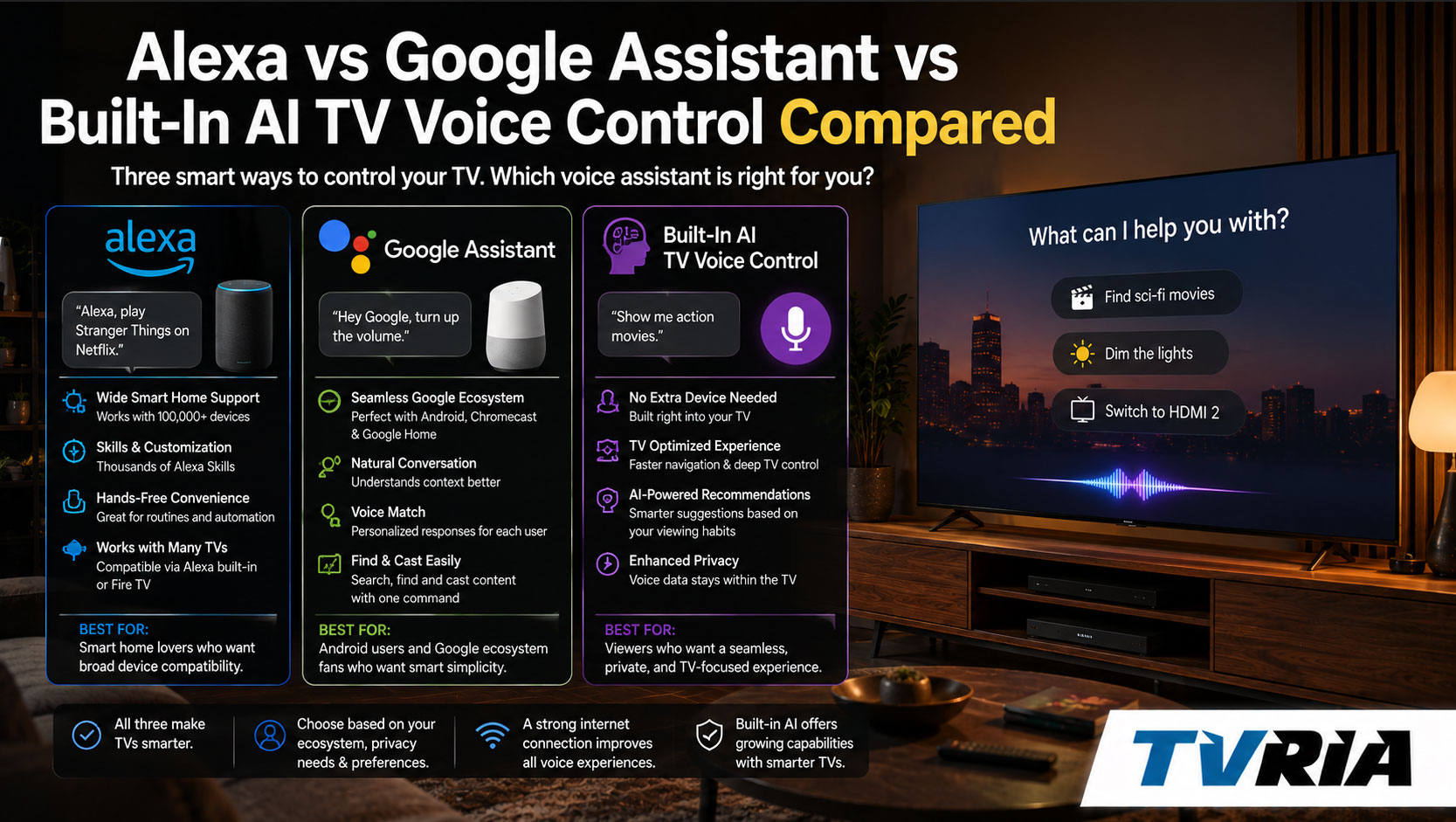
There was a time when "smart TV" just meant a television that could stream Netflix without a separate box plugged into the HDMI port. That bar has moved. In 2026, the real fight isn't over resolution or refresh rates — it's over who gets to answer when you talk to your screen. Amazon, Google, Samsung, and LG are all racing to become the voice your television listens to first, and the answer to "which assistant is best" now depends less on brand loyalty and more on what's actually happening inside these systems.
This piece breaks down the three real options on the table right now: Amazon's Alexa (freshly rebuilt as the generative Alexa+), Google's Assistant (which is being retired and folded into Gemini), and the built-in AI voice systems that TV makers like Samsung and LG now ship natively, without needing Amazon or Google at all. None of these are hypothetical anymore — all three are shipping in real living rooms today, and each one behaves very differently once you actually start talking to it.
Why Voice Control on TVs Suddenly Matters Again
For most of the smart TV era, voice control was a party trick. You'd say "search for The Office," it would technically work, and then you'd go back to using the remote for everything else because the assistant couldn't handle a follow-up question or understand what you meant if you phrased it slightly wrong.
That's changed for one specific reason: large language models replaced rigid command trees. Older assistants matched your sentence against a fixed list of intents. If your phrasing didn't fit the list, you got a shrug and a web search. The new generation — Alexa+, Gemini, and the generative layers Samsung and LG have built into their own TV software — actually parses what you mean, remembers what you said thirty seconds ago, and can chain several actions from a single sentence.
The practical result is that "find me something funny, not too long, that we haven't seen" is now a request a TV can plausibly handle, instead of a request that returns a list of everything tagged "comedy."
Meet the Three Contenders
Amazon Alexa (Now Alexa+)
Amazon relaunched its assistant nationwide in the US on February 4, 2026, as Alexa+, a generative AI rebuild running on a mix of Amazon's own Nova models and third-party AI systems. It's free for the roughly 180 million US Prime members and available with usage limits — or a $19.99/month subscription — for everyone else. Unlike the old command-based Alexa, Alexa+ can hold multi-turn conversations, remember context, and act as an agent that completes multi-step tasks rather than answering one narrow request at a time.
On TVs specifically, Alexa shows up two ways: built directly into Amazon's own Fire TV hardware, and as a "works with Alexa" integration on third-party sets from Samsung, LG, TCL, and others via an Echo device or an Alexa-enabled remote. Amazon's headquarters is at 410 Terry Avenue North, Seattle, WA 98109, and its Devices & Services division — the team building Alexa+ and Fire TV — operates out of that same Pacific Northwest campus.
Google Assistant (Being Replaced by Gemini)
Google Assistant, which launched in 2016, is being formally phased out. Gemini for Home already replaced Assistant on more than 800 million connected speakers, displays, and cameras as of October 2025, and Google has confirmed Assistant will begin shutting down on mobile and Wear OS devices starting September 4, 2026. Gemini is also rolling out to Google TV, though so far it's live on a limited set of hardware — TCL's QM9K series was first, launched in September 2025.
That means anyone buying a Google TV-powered set in 2026 is really buying into a transition: today's TV may still run classic Assistant-style commands, but the underlying engine is being swapped for Gemini, Google's conversational, context-aware system that can answer open-ended questions, pull in your calendar, and follow up on what you just asked without you repeating yourself. Google's headquarters sits at 1600 Amphitheatre Parkway, Mountain View, CA 94043, and the Google TV and Gemini for Home teams are based there.
Built-In AI TV Voice Control (Samsung Vision AI / Bixby, LG webOS AI)
This is the newest and, arguably, most interesting category — voice assistants that live entirely inside the television's own operating system rather than being borrowed from a phone company.
Samsung's approach is called Vision AI Companion, and its 2026 TV lineup runs it through an upgraded, conversational version of Bixby, alongside optional access to Microsoft Copilot and Perplexity as alternative AI layers on the same screen. You wake it with "Hi Bixby" or the mic button on the remote, and it can hold a follow-up conversation, explain what's on screen, or navigate settings without menu-diving. Samsung's global headquarters is located at Samsung Electronics Co., Ltd., 129 Samsung-ro, Yeongtong-gu, Suwon-si, Gyeonggi-do, South Korea.
LG's 2026 sets ship with what the company calls a multi-AI architecture inside webOS 26 — voice requests are routed on the fly to whichever AI engine (LG's own ThinQ AI, or in some regions, third-party AI search) is best suited to answer, rather than locking you into a single assistant. On top of that, LG TVs still support built-in Alexa and Google Assistant/Gemini integrations for households that want to stick with a familiar ecosystem. LG Electronics' headquarters is at LG Twin Towers, 128 Yeoui-daero, Yeongdeungpo-gu, Seoul, South Korea.
How They Actually Work Under the Hood
The architecture differences matter more than the marketing suggests.
Alexa+ blends Amazon's proprietary Nova large language models with outside AI systems, and Amazon has said many simple, low-stakes requests (adjusting volume, setting a timer) are processed on-device rather than sent to the cloud, which helps with both speed and privacy. Gemini, by contrast, is Google's own frontier model family end to end, which gives it an edge in general knowledge and reasoning but ties it tightly to a Google account and Google's cloud. Samsung and LG's built-in systems take a hybrid, almost federated approach: a native assistant (Bixby or ThinQ AI) handles TV-specific control, while separate AI apps — Copilot, Perplexity, or a routed multi-AI layer — get pulled in for open-ended questions the native assistant isn't built to answer.
In practice, that means Alexa and Gemini are trying to be the one assistant for your entire digital life, with the TV as just one more surface. Samsung and LG are trying to make the TV itself intelligent, with outside AI models treated as guest experts rather than the primary brain.
Head-to-Head Comparison Table
| Feature | Amazon Alexa+ | Google Assistant / Gemini | Built-In TV AI (Samsung Vision AI / LG webOS AI) |
|---|---|---|---|
| Underlying tech | Amazon Nova + third-party LLMs | Google Gemini | Bixby (Samsung) / ThinQ AI + routed third-party AI (LG) |
| Availability on TVs | Fire TV native; third-party sets via Echo/remote skill | Google TV native (limited models so far); phasing out on mobile Sept 2026 | Native on Samsung Vision AI TVs and LG webOS 26 TVs |
| Conversational memory | Yes — multi-turn, context aware | Yes — multi-turn, context aware | Partial — improving with Bixby's generative update and LG's multi-AI routing |
| Smart home control | Very strong; huge third-party device catalog | Very strong; deep Google Home/Matter integration | Strong for the TV brand's own appliances (SmartThings/ThinQ); Alexa/Google add-ons available for the rest |
| Cost | Free with Prime; $19.99/mo otherwise | Free (bundled with device/account) | Free with TV purchase |
| Cross-device consistency | High — Echo, Fire TV, phone, car (BMW iX3 2026) | High — phone, Wear OS, car, Home speakers, TV | Limited to the TV brand's own ecosystem |
| Data handling | Mix of on-device and cloud processing | Primarily cloud-based via Google account | Varies; some processing on-device, some through partner AI apps |
| Best for | Amazon Prime households, smart home hubs | Android and Google Home households | Buyers who want one clean voice experience without linking accounts |
Voice Recognition and Natural Language Understanding
This is where the generational leap is most obvious. Older Alexa and Assistant needed near-exact phrasing — "Alexa, play jazz on Spotify" worked; "Alexa, put on something chill and instrumental" often didn't. Alexa+ and Gemini both handle vague, layered requests now, including follow-ups like "actually, something with vocals" without restarting the whole command.
Samsung's upgraded Bixby has closed much of that gap too, understanding context and follow-up questions rather than requiring a fresh wake word for every request. LG's multi-AI routing in webOS 26 is designed around the same problem — matching a vague or incomplete request to whichever AI engine is likeliest to understand it, rather than forcing users to phrase things a specific way. The honest caveat across all three: accent, dialect, and background noise still trip up every system to some degree, and Samsung itself notes that its voice commands don't recognize all accents and expressions even in the languages it supports.
Smart Home Integration
If your house is already full of Alexa-compatible plugs, bulbs, and locks, Alexa+ on your TV is the path of least resistance — Amazon's third-party device catalog is still the largest in the industry, and Alexa+ is available on the overwhelming majority of Amazon devices already shipped, including Fire TV.
Gemini inherits Google Home's Matter-based smart home stack, which is arguably the most technically modern of the three, given Google's early and consistent investment in the Matter standard. If your smart home already speaks Google Home, a Gemini-powered TV slots in cleanly.
Built-in TV AI is strongest when it stays inside its own brand's walled garden — Samsung's Bixby controlling SmartThings-connected appliances (including, notably, opening a Bespoke refrigerator door hands-free while your hands are full), or LG's ThinQ AI managing LG washers, dryers, and air conditioners through the same voice command that adjusts the TV volume. Step outside that brand ecosystem, though, and you're usually back to linking Alexa or Google Assistant as a bridge, which both Samsung and LG explicitly support.
Content Discovery and Search
This is arguably the single most-used voice feature on any TV, and it's also where the three approaches diverge the most visibly. Alexa+ leans into planning and task execution — asking it what to watch tends to produce competent but fairly literal genre or actor-based matches. Gemini, tested on TCL's early Google TV rollout, can take an open-ended prompt like "explain what's happening in this show" or pull in outside context such as your calendar or the weather mid-conversation, which points toward search that goes beyond the on-screen catalog. Samsung's Vision AI Companion is explicitly built around this use case — asking questions about what's on screen and getting an answer without leaving the show — and gives users the option to route trickier questions to Microsoft Copilot or Perplexity instead of Bixby.
Privacy and Data Handling
None of these systems are silent about the fact that a smarter assistant needs more data to work well, and each has made different promises about where that data goes.
Amazon has said Alexa+ processes simple requests on-device using newer silicon, only sending audio to the cloud for more complex, generative tasks, and Echo devices retain the physical microphone mute button as a hardware-level opt-out. Google's Gemini, by contrast, is fundamentally a cloud-based system tied to your Google account, which brings stronger personalization at the cost of more centralized data collection. Samsung and LG's built-in systems sit somewhere in between, with the added wrinkle that routing a question to a third-party AI app like Copilot or Perplexity means that request is now also subject to that third party's own privacy policy, not just the TV manufacturer's. Anyone particularly sensitive about an always-listening microphone in the living room should check each brand's current privacy documentation directly, since these policies have been shifting quickly through 2026.
Multi-Room and Multi-Device Control
Alexa's biggest practical advantage is breadth: the same assistant that runs your Fire TV also runs Echo speakers, smart plugs, and, as of CES 2026, the 2026 BMW iX3's in-car assistant — meaning the voice profile and preferences genuinely travel with you between rooms and even between the house and the car. Gemini is chasing the same goal across Android phones, Wear OS watches, Android Auto, and Google Home speakers, though the migration is happening in stages through 2026 and not every device has switched over yet. Built-in TV AI, by design, doesn't really try to compete here — Bixby and LG's ThinQ AI are TV-first (and appliance-adjacent) rather than whole-home-first, which is a real limitation if your ambition is one assistant for every room in the house.
Setup and Learning Curve
Built-in TV AI wins this category by a wide margin, simply because there's nothing to set up. Turn on a 2026 Samsung or LG set, and Bixby or ThinQ AI is already listening through the remote's microphone button — no app pairing, no account linking required for basic TV control.
Alexa and Gemini both require more plumbing. Getting Alexa to control an LG appliance, for instance, means enabling a specific skill in the Alexa app, signing in with your LG account, and running a device discovery step — a process LG documents in detail because it trips people up often enough to need a support page. Gemini on Google TV currently has an even steeper practical hurdle: it's only live on select hardware (TCL's QM9K series being the first), so most Google TV owners are still using classic Assistant while they wait for their model to get the upgrade.
Price and Ecosystem Lock-In
Alexa+ is free if you're already a Prime member (Amazon Prime membership itself runs $139/year in the US); non-members can use a limited free tier or pay $19.99 a month for full access. Gemini's TV rollout hasn't introduced a standalone TV subscription fee yet, but early coverage has noted that some advanced Gemini features on Google TV are arriving alongside premium hardware rather than as a free update to existing sets. Built-in TV AI is the simplest financially — it comes with the television, full stop — though the trade-off is that you're locked into whichever brand you bought, and switching TV manufacturers later means relearning a different voice system.
Which One Should You Actually Use?
If your smart home is already built around Echo devices, plugs, and routines, or if you want one assistant that follows you into your car and your kitchen, Alexa+ is the least friction. If you're deep in the Android and Google Home ecosystem and don't mind being an early adopter while Gemini's TV rollout catches up to its phone rollout, Gemini is clearly the more technically ambitious long-term bet — but be aware that Assistant's shutdown timeline (starting September 4, 2026) means the transition is happening whether you plan for it or not. If you just bought a Samsung or LG flagship TV and mostly want fast, accurate control of the TV itself and the brand's own appliances without linking any outside account, the built-in AI is genuinely good enough now that reaching for a third-party assistant may not add much.
For households that don't want to choose, the good news is that you largely don't have to. Both Samsung and LG TVs now support Alexa and Google Assistant/Gemini as add-on options layered over the native voice system, so it's entirely possible to keep your TV brand's built-in assistant for day-to-day control while still asking Alexa to dim the lights.
The Verdict
There isn't a single winner here, and treating this as a simple ranking misses the more useful takeaway: these three approaches are optimizing for different jobs. Alexa+ optimizes for breadth across your entire home and increasingly your car. Gemini optimizes for depth of reasoning and Google account integration, at the cost of a still-unfinished rollout. Built-in TV AI optimizes for zero-setup simplicity and tight integration with one brand's own appliances, at the cost of everything outside that brand feeling like an afterthought.
The most honest advice for 2026 is to match the assistant to the ecosystem you're already living in, rather than picking whichever one had the flashiest keynote demo. Voice control on TVs has finally gotten good enough to matter daily — the remote isn't going away, but for the first time, it's no longer the only reliable way to talk to your television.
Frequently Asked Questions
Is Google Assistant going away completely? Not entirely. Google Assistant begins shutting down on Android phones, tablets, and Wear OS devices starting September 4, 2026, with Gemini taking over. Cars with "Google built-in" keep Assistant for now, and the transition to Gemini on Google TV, Google Home speakers, and smart displays is happening on a separate, ongoing timeline.
Do I need Alexa or Google Assistant if my TV already has built-in AI? No. Samsung's Vision AI Companion (with Bixby) and LG's webOS AI both work as complete, standalone voice systems out of the box. Alexa or Google Assistant/Gemini become useful add-ons if you want the TV's voice control to reach smart home devices or services outside that TV brand's own ecosystem.
Which assistant handles smart home devices best? Amazon Alexa currently has the broadest third-party smart home device compatibility, followed closely by Google's Gemini/Google Home stack thanks to its Matter integration. Built-in TV assistants are strongest with their own manufacturer's appliances and typically need Alexa or Google Assistant layered on top for broader compatibility.
Is Alexa+ free? It's free for Amazon Prime members. Non-Prime users get a limited free tier through the Alexa app and Alexa.com, with a $19.99/month subscription available for full access.
Does a smarter TV assistant mean more of my data gets collected? Generally yes, since generative, context-aware responses require more processing than the old fixed-command systems. Amazon has said it handles many simple Alexa+ requests on-device, while Gemini relies more heavily on cloud processing tied to your Google account. It's worth checking each company's current privacy documentation, since policies here have been changing quickly through 2026.