
Are Curved TVs Still Worth It in 2026?
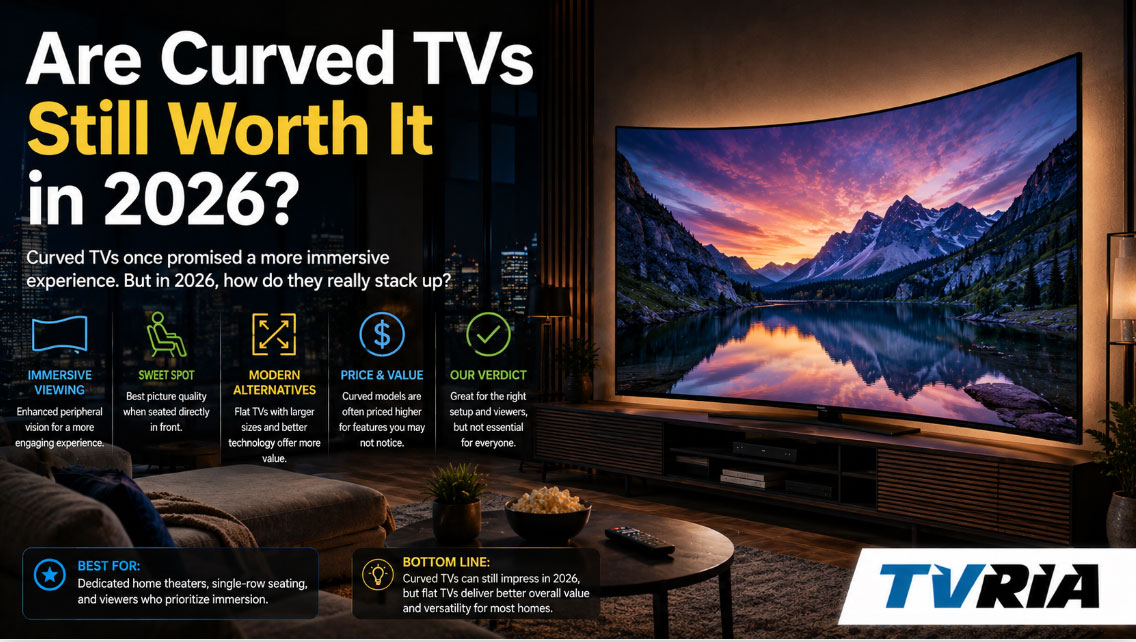
There was a moment, somewhere around 2014, when every electronics showroom on earth seemed to bend at the middle. Curved televisions lined the walls of Best Buy, Currys, and MediaMarkt like a fleet of shallow satellite dishes, each one promising to fold you into the picture the way a planetarium dome folds you into the stars. Samsung called it immersive. LG called it cinematic. Sales reps called it the future.
Twelve years later, the future looks flat again. Literally.
So here's the question worth asking honestly, not as a nostalgia trip but as a real 2026 buying decision: if you're staring at a curved TV in a clearance bin, a marketplace listing, or a friend's slightly outdated living room, is it still a smart purchase? Or is it a design fad that outlived its usefulness and just hasn't been swept off the shelf yet?
The short answer is that the curve, as a living-room television feature, has quietly exited the stage. The longer answer — the one that actually helps you make a decision — is more interesting, and it involves gaming monitors, OLED panels, and a physics argument that never really held up the way marketing departments wanted it to.
A Decade of Bending the Rules: Where Curved TVs Came From
To judge whether curved TVs still deserve a place in your home, it helps to remember why they showed up in the first place.
The pitch was elegant on paper. A flat screen presents every pixel at a slightly different distance from your eyes, because the edges of the panel are farther away from you than the center. A curve, the theory went, equalizes that distance — every part of the image sits roughly the same length from your pupils, mimicking the way an IMAX screen or a cockpit windshield wraps around your peripheral vision. Manufacturers threw around numbers like 4000R (meaning the curve, if extended into a full circle, would have a 4,000mm radius) as though they were describing an optical breakthrough rather than a bent sheet of glass.
For a couple of years, it worked as a differentiator. Curved sets were positioned as the premium tier, sitting above flat panels in showroom hierarchies and price tags alike. Samsung's curved UHD and early QLED lines, LG's curved OLEDs, and a wave of budget Chinese and Korean brands all raced to bend their glass before consumers cooled on the idea.
And cool they did. By the late 2010s, the novelty had worn thin, and the flaws that reviewers had flagged from day one — off-center distortion, awkward wall mounting, reflections that behaved unpredictably — started to outweigh the sense of spectacle. Samsung and LG both scaled curved TVs back to a handful of legacy SKUs before phasing them out of their flagship lineups almost entirely.
The Verdict Nobody Wanted to Hear: 2026's Lineups Have Moved On
If you want proof that the industry has made up its mind, you don't need an opinion piece — you need a spec sheet. Samsung's full 2026 television lineup, announced across CES and its regional launches this year, spans Micro RGB LCD, Neo QLED, OLED, Mini LED, and The Frame's art-display line. The lineup expands AI-powered features across Micro RGB, OLED, Neo QLED, Mini LED and UHD models as part of Samsung's push to make artificial intelligence central to the TV experience. Nowhere in that list is a curved category.
Even more telling is what happened to the QN90F, Samsung's most popular Neo QLED for years. There is no direct 2026 successor carrying the same name — the QN90 series has been discontinued entirely, replaced by the R85H, a new RGB LED LCD model slotted between the Neo QLED and OLED tiers. That's a flagship-level product being retired and replaced by something flat, not curved.
Samsung's broader 2026 story leans hard into flat-panel technology instead: a Micro RGB backlit LCD lineup expanding beyond last year's single 115-inch model, new sizes for the R95H, and OLED refinements including glare-free coatings originally introduced on the S95F and QN90F. The company's 2026 OLED range — the S99H, S95H, S90H and S85H — is entirely flat, as is its Neo QLED, Mini LED, and The Frame lineup for the year. Curvature simply isn't part of the conversation anymore for the world's largest TV manufacturer, and LG, Sony, and TCL have followed a nearly identical path, concentrating their marketing dollars on OLED brightness, Mini LED zone counts, and AI upscaling instead of screen geometry.
What curved TVs exist in 2026 tend to fall into one of two buckets: leftover retail inventory from Samsung's 2014-2019 curved UHD and early QLED generation, still occasionally sold through clearance channels and secondary markets, or budget-tier and off-brand sets manufactured primarily for markets where the curve still reads as a premium visual cue rather than a proven performance advantage.
Why the Curve Lost the Argument
None of this happened by accident. Reviewers, engineers, and, eventually, ordinary buyers converged on the same set of complaints.
The Off-Axis Seating Problem
A curved screen is optimized for one seat: dead center, at a specific distance. Move to the side — onto the other end of the sofa, into an armchair, or just closer to grab a snack — and the image distorts. Straight lines near the edges appear to bow, reflections shift asymmetrically, and colors can shift slightly depending on the viewing angle. A flat panel, particularly modern OLED and Mini LED models with wide-angle coatings, doesn't have a "best seat." Every seat is the best seat, which matters enormously for a shared living room where three or four people are rarely sitting in a perfect row facing the screen.
Wall-Mounting Headaches
Curved TVs never sat flush against a wall. Depending on the model, the mounting bracket had to hold the panel several inches off the surface, which meant visible gaps, awkward cable management, and a bulkier overall footprint. Flat panels, especially the ultra-thin OLED and QD-OLED designs common in 2026, can sit almost flush against drywall, which matters more than it sounds like it should once you've actually tried to hang a curved 65-inch set in a small apartment.
Reflections in a Different Direction
The sales pitch claimed curves reduced glare by directing ambient light away from the viewer. In practice, curved screens simply moved the reflection problem around rather than solving it — a window or lamp that wouldn't bother a flat screen could create a stretched, distorted glare streak across a curved one, and that streak moved unpredictably as you shifted position.
OLED Made the Case Moot
Perhaps the biggest reason curvature stopped mattering is that the problems it was trying to solve — poor contrast, weak black levels, harsh reflections — got solved a different way. OLED panels emit their own light at the pixel level, which means no backlight bleed, near-infinite contrast, and far more consistent color from wide viewing angles than the LCD panels that curved TVs were built on. Once OLED (and later QD-OLED and Micro RGB) delivered that immersive, "you're inside the picture" quality without bending the glass, the curve lost its last real selling point.
But Here's the Twist: Curves Didn't Die, They Downsized
Here's where the story gets more interesting than a simple eulogy. The curve didn't disappear from displays — it migrated from the living room to the desk, and on the desk, it's thriving.
Curved and ultrawide gaming monitors are one of the healthiest corners of the display market heading into the back half of 2026. Curved OLED ultrawides have become the flagship design in gaming monitors this year, with most curved gaming monitors now using curvature radii between 1000R and 1800R — noticeably tighter, and therefore more pronounced, than the 3000R-4000R curves that living-room TVs used. Market researchers tracking the category project continued double-digit growth through the decade as adaptive sync, higher refresh rates, and OLED integration keep pulling gamers toward wider, more wrapped fields of view.
Why does the same geometry that failed in the living room succeed at the desk? Because the two use cases solve completely different problems.
A television serves a room. Multiple people, multiple seating positions, multiple viewing distances, all sharing one screen for two or three hours at a stretch. A curve that's perfect for the center seat is compromised for every seat.
A monitor serves one person, sitting at a fixed, predictable distance, almost always dead center, for extended focused sessions. That's precisely the scenario curvature was designed for. On a 34-inch or 49-inch ultrawide monitor, a tight curve keeps the far edges of the screen roughly equidistant from your eyes, reduces the head-turning required to track fast motion at the periphery, and can meaningfully cut down on eye strain during long sessions — genuine, measurable benefits rather than marketing poetry, because the single-viewer assumption actually holds.
So the honest 2026 take isn't "curved displays are obsolete." It's "curved TVs were solving a single-person problem in a multi-person product category, and the market eventually noticed."
If You Already Own One: Should You Upgrade?
If there's a 2016-era curved Samsung or LG sitting in your living room right now, the practical question isn't philosophical — it's whether the picture quality gap has become large enough to justify replacing a working television.
For most owners, the honest answer is: not urgently, but soon. A decade-old curved LED or early QLED panel is going to fall behind current flat OLED and Mini LED sets in every measurable way — contrast, brightness, color volume, motion handling, and smart platform responsiveness. If your set still does its job for casual viewing and nothing is physically failing, there's no rule that says you must chase the latest panel technology. But if you're noticing dim highlights, washed-out shadows, sluggish menus, or an aging remote that's stopped syncing reliably, that's less about the curve being outdated and more about a nine- or ten-year-old television reaching the natural end of its competitive life. When you do replace it, you'll almost certainly end up with a flat panel anyway, simply because that's what's actually being manufactured at every price tier now.
One thing worth flagging for anyone hanging onto legacy hardware: replacement parts, curved-specific wall mounts, and manufacturer support for those older curved lines are only going to get scarcer. If a repair becomes necessary, budget for the possibility that "fixing it" quietly turns into "replacing it."
If You're Shopping New or Used Curved TVs in 2026
Because curved televisions have essentially vanished from flagship lineups, most of what you'll find labeled "curved TV" for sale right now falls into a narrower, riskier set of categories, and it's worth knowing what you're actually looking at before you buy.
Discounted legacy inventory. Retailers occasionally clear out remaining stock of older curved Samsung or LG panels at aggressive discounts. These can be reasonable value buys for a secondary room or a budget setup, but you're buying a design that's five to ten years behind current panel technology, with a shorter remaining support window.
Budget and off-brand imports. A wave of lower-cost curved sets, often from manufacturers focused on price-sensitive markets, continues to circulate through online marketplaces. Build quality, color accuracy, and long-term reliability on these vary enormously, and because they sit outside the mainstream review ecosystem, it's harder to verify claims before buying. Independent testing outlets flag VA-panel light leakage and inconsistent smart-platform support as recurring complaints in this segment.
Marketplace and resale listings. Secondhand curved TVs are common on general resale platforms, typically priced anywhere from roughly $150 for older, smaller units up into the low thousands for rarer premium curved OLEDs from their brief production run. If you go this route, treat it like buying a used car: ask about burn-in (a real risk on older OLED units), check for dead pixels, and confirm the remote and smart features still function, since firmware support for discontinued curved lines is winding down.
The pattern across all three categories is the same: you're not choosing curvature as a feature anymore, you're choosing it as a compromise that comes bundled with an older or less-vetted product. That's a fundamentally different purchase decision than it was in 2015.
The Alternatives Worth Your Money in 2026
If the appeal of a curved TV was always about immersion — that sense of being pulled into the picture — the good news is that 2026's flat-panel technology delivers that feeling more convincingly than curvature ever did.
OLED and QD-OLED remain the reference point for picture quality this year, with near-perfect black levels and viewing angles that stay consistent no matter where you sit. Samsung's 2026 OLED range pushes brightness further still, with early reporting suggesting its flagship panels could reach significantly higher peak brightness than last year's already-strong QD-OLED flagship, narrowing the gap with LCD-based sets in bright rooms while keeping OLED's contrast advantage.
Neo QLED and Mini LED sets remain the value-conscious choice for bright living rooms, using dense backlight zones to chase OLED-like contrast at a lower price point, with Samsung's 2026 QN80H and QN70H representing the current mid-range standard.
Micro RGB is the newest wrinkle in the flat-panel story — a backlighting approach using individually addressable red, green, and blue LEDs instead of white LEDs with a color filter, aimed at wider color volume and better brightness efficiency than traditional Mini LED. Samsung is positioning it as the successor to the role its now-discontinued QN90F used to fill.
Large-format flat panels, 75 inches and up, achieve a version of "immersive" through sheer scale rather than curvature — for viewers who genuinely want to feel wrapped in the picture, going bigger and staying flat now outperforms going curved at a smaller size.
None of these require you to compromise on seating position, wall-mount depth, or off-axis color accuracy the way a curved panel does. That's the real reason the industry moved on: it found ways to deliver the emotional promise of curvature without the physical trade-offs.
So, Is It Worth It? A Straight Answer About a Curved Screen
For a living room television in 2026, no — a curved TV is not worth prioritizing, and if one is presented to you as a premium option at a premium price, that pricing reflects scarcity and nostalgia more than any measurable performance edge. The manufacturers that pioneered the format have moved on, the panel technology that made curvature appealing has been surpassed by OLED and Mini LED innovations that work for every seat in the room, and the practical downsides — off-axis distortion, mounting difficulty, unpredictable glare — never fully went away.
For a personal desk setup, particularly gaming, the answer flips. A curved ultrawide monitor, viewed from a single fixed position at a predictable distance, delivers exactly the kind of immersion curved TVs always promised and rarely delivered, which is why that segment of the display market is growing rather than shrinking.
The honest framing isn't "curved displays failed." It's "curved TVs were the wrong shape for a shared room, and curved monitors are the right shape for a single chair."
Quick Buying Checklist Before You Decide
- If you're replacing a living-room TV, default to a flat OLED, QD-OLED, Mini LED, or Neo QLED panel matched to your room's brightness and budget.
- If you're building a gaming or work desk, a curved ultrawide monitor (1000R–1800R) is a legitimate, evidence-backed upgrade for a single-viewer setup.
- If you're eyeing a discounted or secondhand curved TV, price it as an aging or niche product, verify remaining warranty or support, and check for burn-in on any OLED unit.
- If immersion is the goal, consider that a larger flat screen or a closer seating distance often achieves it more reliably than curvature does.
- Confirm return policies before buying any curved set sight-unseen from a marketplace listing — off-axis performance is hard to judge from photos alone.
Further Reading & Resources
For hands-on testing data and current model comparisons before you buy, these are solid places to dig deeper:
- RTings — independent lab testing and viewing-angle comparisons for current TVs and monitors
- FlatpanelsHD — detailed coverage of manufacturer lineup announcements, including Samsung's and LG's 2026 TV ranges
- Tom's Guide TVs — buying guides and lineup breakdowns updated through the current model year
- Samsung Newsroom — official specifications and availability for current-generation Samsung displays
- LG Electronics — official specifications for current OLED and QNED television lineups
- Newegg Insider — curved and ultrawide gaming monitor trends and comparisons
A curved screen isn't a bad piece of technology. It's just a shape that finally found its correct room — and it's your desk, not your living room.