
Edge-Lit vs Direct-Lit LED Backlighting Explained
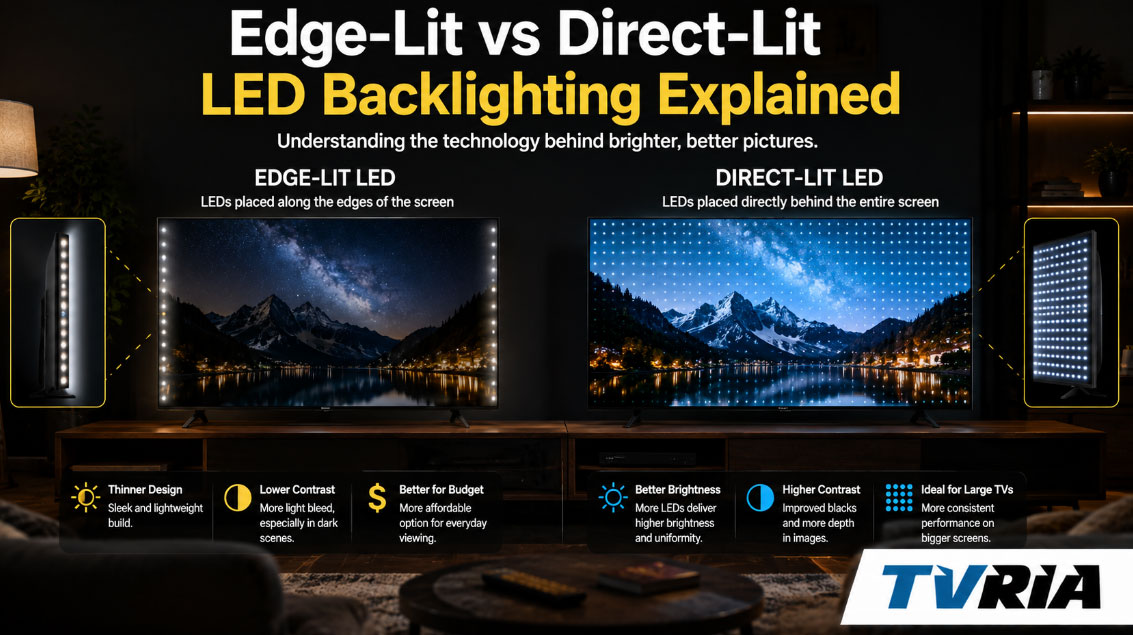
Every LCD screen you have ever owned — a TV, a monitor, a laptop panel — has one thing hiding behind the glass that quietly decides how good the picture looks: the backlight. The pixels themselves don't produce light. They twist and filter light that comes from somewhere else, and where that "somewhere else" sits changes everything about contrast, brightness, uniformity, and price. That's the whole edge-lit versus direct-lit argument in a sentence. But the details are where the decision actually gets made, and that's what this guide is for.
If you're shopping for a new television, a computer monitor, or even a digital signage panel, you'll run into these two terms constantly, often buried in a spec sheet next to words like "full-array," "mini-LED," or "local dimming zones." None of that is marketing fluff you can safely ignore. It directly predicts how deep your blacks will look during a dark movie scene, how much the screen will cost, and how thin the final product can be.
What "Backlighting" Actually Means
An LCD (liquid crystal display) panel is essentially a very sophisticated light valve. A layer of liquid crystals sits in front of color filters and twists in response to electrical current, letting more or less light pass through each subpixel. Without a light source behind that layer, you'd be staring at a dark, lifeless sheet of glass. That's why every LCD — unlike an OLED, which lights up each pixel individually — needs a dedicated backlight assembly.
The backlight is a physical panel of LEDs (light-emitting diodes) placed somewhere inside the screen's chassis. How those LEDs are arranged, and how many of them there are, is what separates edge-lit designs from direct-lit designs. It's not a software feature or a firmware toggle — it's a hardware decision made at the factory, and it can't be changed after the fact.
The Two Core Approaches: Edge-Lit and Direct-Lit
How Edge-Lit Backlighting Works
In an edge-lit panel, LEDs are mounted along the perimeter of the screen — usually the top and bottom, or sometimes just the left and right sides. A light guide plate, a thin sheet of transparent acrylic etched with a microscopic dot pattern, sits behind the LCD layer and redirects that edge light so it spreads out and (in theory) evenly illuminates the whole screen.
This is a clever piece of optical engineering, but it's still light traveling sideways and bouncing forward, rather than shining straight at the pixels above it. That indirection is the root of almost every edge-lit limitation you'll read about.
Edge-lit designs became the dominant approach in slim TVs and monitors for a simple reason: fewer LEDs and a thinner light guide plate mean a thinner, lighter, cheaper panel. If you've ever admired how impossibly slim a modern television looks mounted on a wall, you're looking at edge-lit engineering doing its job.
How Direct-Lit Backlighting Works
Direct-lit backlighting flips the layout. Instead of ringing the edges, LEDs are spread across the entire back panel, directly behind the LCD layer, facing forward. There's no light guide plate doing the heavy lifting — the light source is simply positioned where the light needs to go.
Because the LEDs sit in a grid behind the screen, manufacturers can group them into zones and turn each zone brighter or dimmer independently. This is called local dimming, and it's the single biggest reason direct-lit and full-array designs outperform basic edge-lit panels in contrast and HDR (high dynamic range) content. A "full-array" backlight is really just a direct-lit backlight with local dimming zones spread evenly across the entire panel, rather than only a handful of large zones.
Where Mini-LED and Full-Array Fit In
Mini-LED isn't a competing category — it's a refinement of direct-lit and full-array technology. Traditional direct-lit LEDs are relatively large, which limits how many dimming zones a panel can realistically pack in without ballooning the cost and thickness. Mini-LEDs measure a fraction of the size — often well under a millimeter — which lets manufacturers cram thousands of individual LEDs and hundreds or even thousands of dimming zones into the same panel space.
More zones mean finer control over which parts of the screen go dark and which stay bright, which in turn reduces a visual artifact called "blooming" — the faint halo of light you sometimes see around a bright object on a dark background, like subtitles on a night scene. A handful of years ago, having 100 or so dimming zones was considered solid performance. Current mini-LED panels frequently pack in several thousand zones, a jump that has meaningfully closed the gap with OLED in dark-room contrast.
It's worth being precise with terminology here, because manufacturers aren't always consistent:
- Edge-lit — LEDs on the perimeter, light guided inward.
- Direct-lit (basic) — LEDs spread across the back, but sometimes with no or very few dimming zones.
- Full-array — Direct-lit with LEDs evenly distributed and grouped into local dimming zones.
- Mini-LED — Full-array taken further, using much smaller LEDs to multiply the number of dimming zones.
- Micro-LED — A completely different, self-emissive technology with no backlight at all, closer in concept to OLED than to any LCD backlighting method.
Contrast and Black Levels: The Real Battleground
This is where the two technologies diverge the most, and it's the reason most people care about this topic at all. Contrast — the difference between the darkest and brightest parts of an image — is what gives a picture depth and makes HDR content look genuinely different from standard video.
Edge-lit panels struggle here because the light guide plate spreads illumination across the whole screen fairly indiscriminately. Even edge-lit sets with "local dimming" can usually only dim broad vertical or horizontal strips, not small, precise regions. The result: when a scene has both a bright object and deep shadow, the edge-lit backlight has to compromise, often turning true black into a slightly glowing dark gray.
Direct-lit and full-array panels, especially mini-LED versions, can dim the exact zone behind a dark part of the screen while keeping a nearby zone at full brightness. That precision is what produces the "pop" people notice in HDR movies and games — bright highlights like fire, headlights, or sunlight coexisting with genuinely dark shadows in the same frame.
Brightness and HDR Performance
Peak brightness matters for HDR because formats like HDR10 and Dolby Vision are mastered assuming the display can hit high nit values for small highlights. Direct-lit panels generally have an advantage here too, simply because there are more LEDs distributed across a larger surface area, giving the panel more raw light output to work with. Edge-lit panels, with their LEDs concentrated at the perimeter, tend to hit a ceiling on peak brightness sooner, and that ceiling matters a lot once you're watching HDR content mastered for 1,000 nits or more.
That said, edge-lit panels aren't dim by any means — plenty of them look perfectly bright in a well-lit living room for daytime sports or casual streaming. The gap shows up specifically in scenes that ask the screen to be simultaneously very bright and very dark.
Uniformity and Blooming
Uniformity refers to how evenly lit the screen looks when displaying a single flat color, like gray or white. Direct-lit panels tend to win this comparison too, precisely because the light source is distributed across the whole back panel rather than concentrated at the edges. Edge-lit screens can develop visible "hot spots" near the LEDs and a dimmer center, especially on larger screen sizes where the light guide plate has to work harder to spread illumination evenly.
Blooming, mentioned earlier, is really a side effect of dimming-zone size rather than the edge-lit/direct-lit split on its own. A basic direct-lit panel with only a few large zones can still bloom noticeably. It's really mini-LED's high zone count that solves this problem well, which is why "direct-lit" alone isn't automatically a guarantee of a blooming-free picture — you need the zone count to go with it.
Thickness, Weight, and Design
If a razor-thin profile is a priority — think ultra-slim TVs meant to sit nearly flush against a wall — edge-lit is usually the only realistic option. The light guide plate is thin, the LED strips are compact, and there's no need for a deep cavity behind the panel to house a full grid of LEDs and their heat-management hardware.
Direct-lit and full-array panels are inherently thicker, since the LEDs need physical distance from the LCD layer to diffuse properly before reaching the pixels — otherwise you'd see individual points of light rather than smooth illumination. That extra depth adds weight too, something worth considering if you're wall-mounting a large panel with a mount rated for a specific weight range.
Mini-LED has narrowed this gap somewhat, since smaller diodes need less diffusion distance, but mini-LED TVs are still generally thicker than their edge-lit counterparts of the same screen size.
Power Consumption and Efficiency
Edge-lit backlighting typically uses fewer total LEDs, which usually — though not always — translates to lower power draw. For manufacturers building budget or ultra-portable products, that efficiency advantage stacks nicely with the reduced material cost.
Direct-lit and full-array panels, with LEDs spread across the entire back panel, generally consume more power in absolute terms. Modern local dimming algorithms claw some of that back by turning off LEDs behind dark image areas entirely, but a direct-lit or mini-LED panel showing a bright, uniform white screen will typically draw more power than an edge-lit equivalent showing the same image.
Cost Considerations
Cost follows LED count and structural complexity almost directly. Edge-lit remains the budget-friendly default across huge swaths of the TV and monitor markets — office monitors, secondary bedroom TVs, budget laptops, and value-tier smart TVs almost universally use edge-lit backlighting because it keeps the bill of materials low.
Direct-lit and full-array panels sit in the mid-range and above, where the added contrast and brightness justify a higher price tag for buyers who watch a lot of HDR content or game competitively. Mini-LED sits at the top of the LCD price ladder, often overlapping with — or exceeding — the price of entry-level OLED panels, which raises a legitimate question for shoppers about whether to spend that money on mini-LED or simply jump to OLED instead.
Comparison Table
| Factor | Edge-Lit | Direct-Lit / Full-Array | Mini-LED |
|---|---|---|---|
| LED placement | Perimeter only | Spread across entire back panel | Spread across entire back panel, much smaller diodes |
| Local dimming precision | Low to moderate (large zones or strips) | Moderate (dozens to low hundreds of zones) | High (hundreds to thousands of zones) |
| Black levels | Weakest; dark gray rather than true black | Solid, noticeably deeper than edge-lit | Closest LCD tech gets to OLED-level blacks |
| Peak brightness | Lower ceiling | Higher | Highest among LCD types |
| Blooming/haloing | Least controlled | Reduced, depends on zone count | Best controlled of the three |
| Panel thickness | Thinnest | Thicker | Moderately thick, thinner than basic full-array |
| Weight | Lightest | Heavier | Moderate |
| Power draw | Lowest, generally | Higher | Higher, offset somewhat by smart dimming |
| Typical price tier | Budget | Mid-range to upper-mid-range | Premium |
| Best suited for | Bright rooms, casual viewing, secondary screens, portability | Home theater, HDR movies, mixed-use living rooms | Serious HDR viewing, gaming, home theater on a budget below OLED |
Which One Should You Buy?
Best for Edge-Lit
Edge-lit makes sense if you're outfitting a bedroom, dorm, kitchen, or office where the screen competes with daylight or overhead lighting for most of its life. In a bright room, deep black levels matter far less because ambient light washes out shadow detail anyway. Edge-lit is also the practical choice if a slim, light panel matters — for a wall mount with limited depth clearance, or for a laptop or monitor where thickness and weight are part of the product's whole appeal.
Best for Direct-Lit, Full-Array, and Mini-LED
If the screen is going in a dedicated home theater, a dim living room used mostly at night, or anywhere you plan to watch a lot of HDR movies or play HDR-capable games, direct-lit and especially mini-LED backlighting earn their higher price. The difference is most obvious in dark, high-contrast scenes — a starfield, a night battle, a moody drama lit mostly by a single lamp. Those are exactly the situations where edge-lit backlighting shows its limits and mini-LED shows its strength.
Common Myths Worth Clearing Up
"Direct-lit always means full-array local dimming." Not necessarily. Some budget direct-lit panels have no local dimming zones at all, or only a couple. Always check the specific number of zones, not just the backlight category.
"Edge-lit TVs can't do HDR." They can display HDR-formatted content, but without enough dimming precision, the image won't have the dynamic range HDR was designed to showcase. It'll still play the file; it just won't wow you the way HDR is meant to.
"Mini-LED is the same as OLED." They're both excellent for contrast, but the underlying technology is completely different. OLED lights each pixel individually with no backlight at all, while mini-LED is still an LCD panel with a backlight — just an extremely refined one. OLED still generally wins on per-pixel black levels and viewing angles; mini-LED tends to win on peak brightness and resistance to permanent image retention (burn-in).
"More dimming zones always means a better picture." Zone count matters a lot, but so does the dimming algorithm controlling those zones, panel brightness uniformity, and the overall processing quality of the TV. Two mini-LED TVs with similar zone counts can still look noticeably different.
Longevity, Repairs, and Long-Term Ownership
Backlight type also shapes what happens years down the line, once the LEDs start to age or something goes wrong. Edge-lit panels, with a smaller number of LEDs concentrated in strips along the frame, are comparatively simple to diagnose and repair. A single failed section often shows up as a dark band or dim corner, and because there are fewer physical components, a repair technician has less territory to search when something fails.
Direct-lit and mini-LED panels are a different story. With LEDs distributed across the entire back panel — sometimes thousands of them on mini-LED models — pinpointing a single failed diode or a faulty driver board section takes more time and specialized diagnostic equipment. The upside is that failures tend to be less catastrophic to picture quality overall, since one dead LED among thousands of mini-LEDs is far less noticeable than one dead strip among a handful of edge LEDs.
Heat is the other long-term factor worth knowing about. Edge-lit LEDs, tucked into a slim bezel, can run hotter in a smaller space, which historically has been one contributor to premature LED degradation on older designs. Direct-lit and full-array panels, with LEDs spread across a wider back panel and more room for heat to dissipate, often run cooler on average, which can support longer usable lifespans in demanding, always-on environments like digital signage or command-center displays.
None of this means either technology is unreliable — LED backlights in general are known for lasting tens of thousands of hours before meaningful brightness degradation sets in, far outlasting the CCFL (cold cathode fluorescent lamp) backlights they replaced years ago. But it's a reasonable factor to weigh if the screen will run for extended hours daily, such as in a retail environment, a control room, or a home office.
How to Check What You're Actually Buying
Manufacturers are required to disclose backlight type in most product specification sheets, but the wording varies. Look for terms like "edge-lit," "direct-lit," "full-array local dimming (FALD)," or "mini-LED" in the display specs, and if a dimming zone count is listed, treat it as one of the most useful numbers on the page. Independent review sites do rigorous lab testing of exactly these characteristics and are worth checking before you buy:
- RTINGS.com tests contrast, peak brightness, and local dimming performance with lab measurements for individual TV and monitor models.
- Tom's Guide publishes plain-language explainers and reviews covering backlight types across current TV lineups.
- What Hi-Fi? covers local dimming and backlight technology from a home-theater enthusiast's perspective.
- HowToGeek has approachable breakdowns of edge-lit, direct-lit, and full-array differences aimed at everyday shoppers.
Cross-referencing a couple of these sources against the manufacturer's own spec sheet is usually enough to know exactly what backlighting you're paying for before it arrives at your door.
Frequently Asked Questions
Is direct-lit always better than edge-lit? For contrast, brightness, and HDR performance, yes, direct-lit and full-array designs generally outperform edge-lit. But "better" depends on use case — edge-lit's thinness, light weight, and lower cost are genuine advantages for bright rooms and budget-conscious buyers.
Does edge-lit backlighting affect gaming performance? Backlight type doesn't affect input lag or refresh rate directly, but it does affect how HDR game content looks, particularly in dark scenes with bright highlights like explosions, headlights, or magic effects.
Can I upgrade an edge-lit TV's backlight to direct-lit later? No. Backlight architecture is built into the physical hardware and cannot be changed or upgraded after manufacturing.
Is mini-LED worth the extra cost over standard full-array? If your budget stretches to it and you watch a meaningful amount of HDR content, mini-LED's finer dimming control is a noticeable, not marginal, upgrade over standard full-array. If you mostly watch standard-dynamic-range content in a bright room, the difference will be far less visible.
Do monitors use the same backlight categories as TVs? Yes. Computer monitors use the same edge-lit, direct-lit, full-array, and mini-LED categories, and the same trade-offs around contrast, thickness, and cost apply.
Final Verdict
Neither backlighting method is objectively "wrong" — they're built for different priorities. Edge-lit exists because thinness, weight, and cost matter enormously for a huge share of the screens people buy, and it does that job well. Direct-lit, full-array, and mini-LED exist because contrast and HDR performance matter just as much for another huge share of buyers, particularly anyone building a home theater or gaming setup around dark-room viewing.
The smartest move before buying any LCD screen is to ask exactly what room it's going in and what you'll actually watch on it most. A bright kitchen or office screen doesn't need the deepest black levels money can buy. A dedicated movie or gaming display absolutely does. Match the backlight to the room, not the marketing copy, and the rest of the decision gets a lot easier.