
LG QNED Series Explained: Numbers and Features Decoded
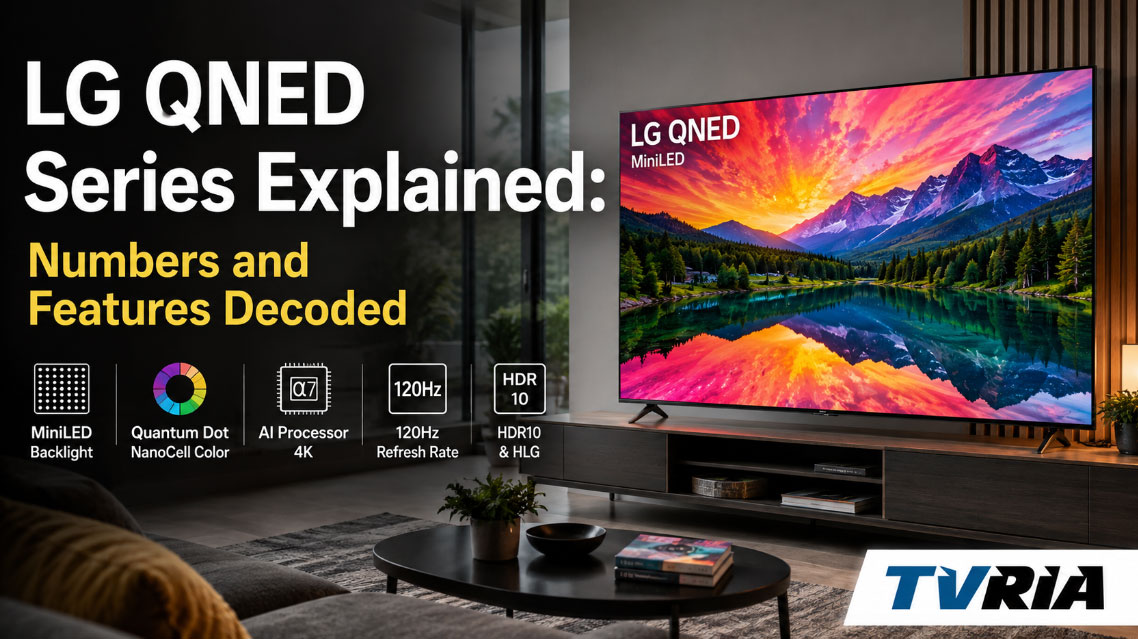
Walk into any electronics showroom and the LG wall will do its best to overwhelm you. QNED90. QNED85. QNED80. QNED70. Letters tacked onto the end that look like a keyboard sneeze. Somewhere in that alphanumeric soup is the actual answer to a simple question: which TV should you buy? This piece pulls the code apart, piece by piece, so the model number stops being a wall of noise and starts reading like the spec sheet it actually is.
Quick Answer: What Is LG QNED?
QNED is LG's mid-to-premium LCD television technology. It layers Quantum Dot color, a NanoCell filtering layer, and Mini LED backlighting on top of a standard LCD panel. The result sits below OLED in absolute contrast but above it in raw brightness, which makes QNED the pick for sun-drenched living rooms, sports-heavy households, and anyone chasing a genuinely enormous screen without an OLED-sized bill. The number after "QNED" in the model name tells you the tier — higher generally means better dimming, brighter peaks, and a faster gaming feature set.
That's the one-paragraph version. Here's the long one.
What QNED Actually Stands For
QNED is short for Quantum Nano-Emitting Diode, and yes, LG built that name specifically so it would sound like it belongs next to OLED and QLED on a shelf tag. It's marketing shorthand for three separate technologies bolted together:
- Quantum Dot — microscopic particles that glow a precise color when struck by light. Smaller dots glow blue, larger ones glow red, and the sizes in between fill out the spectrum. The payoff is a wider, more accurate color gamut than a standard LED panel can manage.
- NanoCell — a filtering layer LG has used since 2019, sitting between the backlight and the pixels to absorb the wavelengths of light that muddy reds and greens. It's the reason NanoCell and QNED sets tend to hold color accuracy at steep viewing angles better than a generic LCD.
- Mini LED backlighting — thousands of LEDs, each far smaller than the ones in a conventional LCD TV, grouped into dimming zones that can brighten or dim independently. More zones means more precise control over where light falls, which narrows the gap with OLED's per-pixel dimming without matching it exactly.
None of these three technologies is unique to LG on its own — Samsung uses quantum dots too, and Mini LED backlighting shows up across brands from TCL to Hisense. What makes QNED a distinct product line is that LG is the only manufacturer stacking all three under one badge, with its own image processing tuned to match.
Cracking the Code: How to Read an LG QNED Model Number
Here's where most shoppers give up and just ask a salesperson, which is exactly the wrong move, because the salesperson is reading the same code you are. Take a typical QNED model number:
65QNED85TUA
Broken into pieces, that string says quite a lot:
- 65 — screen size in inches.
- QNED — the display technology family.
- 85 — the series tier. This is the number that actually separates a budget set from a near-flagship one. Higher is better within a given year: an 85 outranks an 80, which outranks a 70.
- T — the year letter. LG rotates through a letter code each generation instead of printing the year outright on LED, QNED, and NanoCell models. Recent letters run N (2020), P (2021), Q (2022), R (2023), T (2024), A (2025), and B (2026).
- UA — a regional and tuner code. U typically flags an ATSC tuner for North America, and the trailing letter (A, in this case) marks a distribution variant tied to a specific retailer or market. These last two characters don't change picture quality, so they're safe to ignore when comparing two TVs on specs alone.
A Worked Example
So a 2026 flagship-tier QNED might show up as 75QNED90BUA: a 75-inch screen, top-tier QNED processing, built in 2026, for the North American market. A budget 2024 set from the same family might read 50QNED80TUA: same region, same tuner type, but two tiers down and two years older. Line them up side by side and the numbers do the comparing for you.
The Year Letter, Decoded
| Letter | Year |
|---|---|
| N | 2020 |
| P | 2021 |
| Q | 2022 |
| R | 2023 |
| T | 2024 |
| A | 2025 |
| B | 2026 |
Two TVs with the same tier number but different year letters are not the same TV — a QNED85 from 2023 (R) and a QNED85 from 2026 (B) can differ substantially in processor speed, dimming zone count, and gaming specs, even though the "85" suggests equivalence. Always check the year letter before assuming two model numbers are close cousins.
The 2026 LG QNED Lineup, Tier by Tier
LG's 2026 QNED evo range leans hard into ultra-large screens, with the lineup topping out at a 115-inch flagship and a 100-inch model just beneath it — sizes that would have been OLED-only territory a few years ago. The tier structure below runs from the top down.
The Flagship Tier
At the top sits LG's best Mini LED dimming performance and its full AI feature set, including the massive 115-inch and 100-inch panels. This tier gets Precision Dimming Ultra, the newest Alpha AI Processor, and the fastest gaming specs LG offers on an LCD panel — variable refresh rate up to 165Hz and a Motion Booster mode that can push the effective refresh rate to 330Hz on supported content. It's priced accordingly; LG listed its 115-inch flagship at roughly $12,999.99 for the 2026 launch.
The Upper-Middle Tier
One step down, the mid-premium sets keep Mini LED backlighting and most of the color processing from the flagship but trim the dimming zone count and drop some of the sharpest contrast control. Screens here still look bright and punchy — they're simply working with slightly less granular light management in the darkest scenes.
The Value Sweet Spot
This is where LG expects most buyers to actually land. The core QNED benefits — Quantum Dot color, NanoCell filtering, and Mini LED backlighting — are all present, just without the flagship's most aggressive processing or the widest gaming refresh ceiling.
The Entry Point
At the bottom of the QNED range, the sets are built for buyers who want the "QNED" badge and a genuine step up from a basic LED TV without paying for elite HDR performance. Expect solid 4K upscaling and smart features, with more modest brightness and simpler backlight zoning.
| Tier (2026) | Backlight | Best For |
|---|---|---|
| Flagship (90-series) | Mini LED, most zones, Precision Dimming Ultra | Ultra-large screens, serious gaming, bright rooms |
| Upper-mid (82/85-series) | Mini LED, fewer zones | Balanced picture quality without flagship pricing |
| Value (80-series) | Mini LED, standard control | Everyday viewing, general use |
| Entry (70/75-series) | Mini LED, basic implementation | Budget-conscious upgraders |
One honest caveat worth sitting with: LG's exact tier numbering shifts slightly by region and by year, so a "90" in one market's lineup and a "92" in another can refer to the same flagship physical product under a different label. If a number looks unfamiliar, check the specific size's spec sheet rather than assuming the tier digit alone tells the whole story.
What's Actually Inside: The Technology Stack
Quantum Dots, Again — But Why They Matter
The practical benefit of a quantum dot layer isn't an abstract color chart improvement. It shows up as skin tones that don't shift orange under bright light, greens on a football pitch that stay green instead of washing pale, and HDR highlights that keep their hue instead of blowing out to white.
NanoCell Filtering
NanoCell's job is quieter but just as important: it cleans up the light that's already been produced, filtering out the wavelengths that would otherwise blur red and green together into a murky orange. It's a big part of why QNED panels tend to hold their color at wider viewing angles than a plain LED-LCD television, where colors can look washed out the moment you're not sitting dead center.
Mini LED Backlighting and Dimming Zones
Standard LED TVs might use a few dozen backlight zones, if that. Mini LED panels pack in thousands of individually addressable LEDs, grouped into far more zones — which means a bright star field can sit right next to a black sky without the entire corner of the screen glowing gray. It's the single biggest reason a good QNED can approach OLED-like contrast in a dark room, even though the underlying LCD technology hasn't fundamentally changed.
The Alpha AI Processor
Every QNED tier runs on one of LG's Alpha processors, and the generation matters more than shoppers usually realize. The 2026 flagship tier moved to the Alpha 8 AI Processor Gen 3, a chip LG says handles everything from real-time upscaling to sports-specific tone mapping across screens as large as 115 inches. Lower tiers typically run earlier or scaled-down versions of the same chip family, which is one reason picture quality differences between tiers are often more about processing power than panel hardware.
Picture Quality Features, Decoded
Feature names on a QNED spec sheet can read like they were generated to sound impressive rather than to be understood. Here's what they translate to in practice.
Dynamic QNED Color Pro manages how color is mapped as brightness changes, so a scene doesn't lose saturation the instant it gets bright. LG's 2026 flagship and upper tiers carry an Intertek-certified 100 percent color volume rating, meaning the set can reproduce its full color range at both low and high brightness — not just in a dim, low-brightness sweet spot the way cheaper panels often do.
Precision Dimming Ultra is the local-dimming algorithm that decides, zone by zone, how much light to allow through. "Ultra" indicates the most granular version of this system, reserved for the top tier; other tiers use a scaled-back version of the same idea.
AI Super Upscaling takes lower-resolution source content — cable broadcasts, older streaming content, standard-definition footage — and reconstructs detail to better fill a 4K panel. It's the reason a QNED can still look sharp when you're not feeding it native 4K.
Dynamic Tone Mapping Pro adjusts HDR brightness scene-by-scene, or even frame-by-frame, rather than applying one flat brightness curve to an entire movie. Dark scenes stay dark and detailed; bright scenes get pushed toward the panel's real peak brightness instead of being capped by a conservative average.
Gaming and Sound: The Numbers That Matter
Refresh Rate and VRR
LG's 2026 QNED lineup supports Variable Refresh Rate up to 165Hz on the flagship tier, certified through AMD FreeSync Premium, alongside Auto Low Latency Mode. In plain terms: the TV can match its refresh rate to whatever frame rate a game is actually outputting, which eliminates screen tearing and keeps input lag low — the two things competitive gamers actually notice.
Motion Booster
Motion Booster is LG's interpolation-based mode that can push the effective refresh rate up to 330Hz on supported models and content, smoothing out fast motion in shooters and racing games. It's a software-assisted boost rather than a native panel refresh rate, so treat it as a "how smooth does this look" feature rather than a direct latency improvement.
AI Sound Pro
On the audio side, AI Sound Pro analyzes what's on screen and adjusts the virtual surround processing accordingly — dialogue gets pulled forward during a conversation-heavy scene, and effects get spread wider during an action sequence. It's not a replacement for a soundbar, but it's a meaningful step up from a flat television speaker profile.
webOS 26: The Software Layer
Every 2026 QNED ships with webOS 26, and the headline additions lean into personalization and live sports. Voice ID recognizes individual household members by voice and loads that person's customized home screen automatically — useful in a house where three people have three completely different streaming habits. AI Concierge surfaces contextual suggestions and quick actions based on what's currently playing, without requiring you to back out to the home screen. For sports fans specifically, Sports Portal centralizes scores, schedules, and standings, while Sports Alert sends notifications for specific favorite teams — a genuinely practical feature if you've ever missed the start of a game because you didn't know it had moved to a different channel.
QNED vs NanoCell vs OLED: Where It Fits
It's worth placing QNED next to LG's other two major TV lines, since the naming overlap trips up a lot of shoppers.
| NanoCell | QNED | OLED | |
|---|---|---|---|
| Panel type | LCD | LCD | Self-emissive |
| Backlight | Standard LED | Mini LED | None (each pixel is its own light source) |
| Quantum dots | No | Yes | Varies by model |
| Black levels | Good | Very good | Best (true black) |
| Peak brightness | Good | Excellent | Very good |
| Best environment | Any room | Bright rooms | Dark or controlled-light rooms |
| Typical price position | Budget to mid-range | Mid to premium | Premium to flagship |
NanoCell is the entry point: a NanoCell filtering layer over a standard LED backlight, solid color accuracy, and the most accessible pricing of the three. QNED builds directly on top of NanoCell by adding quantum dots and a Mini LED backlight, which is why LG describes it internally as an enhanced NanoCell tier rather than a wholly separate technology. OLED sits apart from both — no backlight at all, since each pixel produces and controls its own light, which is what makes true per-pixel black levels possible in the first place. QNED can't match that, but it counters with significantly higher peak brightness, which matters more than people expect in a living room with windows.
Which QNED Should You Actually Buy?
A few honest rules of thumb, sorted by what actually matters for different households:
- Buying for a bright, sun-lit living room? Prioritize a higher tier number over screen size. The extra dimming precision and peak brightness will matter more than a few extra inches of diagonal.
- Buying primarily for sports? The flagship and upper-mid tiers both support the sports-specific processing and Sports Portal features, so the value tier is a reasonable trade-off if the budget is tight.
- Buying for competitive gaming? Check the VRR ceiling and Motion Booster support on the specific size you want — these specs don't always scale evenly across every screen size within a tier.
- Buying on a strict budget but still want QNED over standard LED? The entry tier still includes Quantum Dot color and NanoCell filtering; it simply asks you to give up the deepest dimming precision.
- Buying for a dedicated, light-controlled home theater? This is the one scenario where it's worth seriously cross-shopping OLED before committing to QNED at all, since true per-pixel black levels are the one thing no amount of Mini LED zoning fully replicates.
Frequently Asked Questions
Is QNED better than QLED?
They're close cousins built on similar ideas — both use quantum dots over an LCD panel — but QNED additionally layers in LG's NanoCell filtering. In head-to-head comparisons the winner usually comes down to the specific model's dimming zone count and processor generation rather than the naming convention alone.
Is QNED the same as Mini LED?
Not exactly. Mini LED describes the backlight hardware, which QNED uses. But QNED adds Quantum Dot and NanoCell layers on top of that backlight, so all QNED TVs are Mini LED TVs, while not all Mini LED TVs (from other brands, or LG's own non-QNED sets) carry the full QNED treatment.
What does the letter at the end of an LG QNED model number mean?
The single letter right after the tier number is the year code (N, P, Q, R, T, A, B for 2020 through 2026). The two or three characters after that are regional and tuner codes that identify the market the set was built for — they don't affect picture quality.
Do higher QNED tier numbers always mean a bigger screen?
No. The tier number describes processing and dimming quality, not size. A 55-inch QNED90 and a 75-inch QNED80 can both exist in the same year's lineup — the tier number is about feature level, the number before "QNED" is the size.
Further Reading and Resources
For readers who want to go deeper on any of the pieces covered here, these are solid starting points:
- LG.com — QNED Mini LED TVs — LG's own current QNED product pages and spec sheets.
- LG Newsroom — 2026 QNED evo Lineup Announcement — the official press release detailing the 2026 tier structure and features.
- tab-tv.com — LG TV Model Number Decoder — a detailed, regularly updated breakdown of every letter and digit in LG's naming system, across OLED, QNED, and NanoCell lines.
- Which? — How to Decode TV Model Names — an independent, consumer-focused explainer covering LG alongside other major brands.
The Bottom Line
An LG QNED model number isn't a marketing riddle — it's a compressed spec sheet. Screen size up front, tier number to signal how good the dimming and processing are, a year letter hiding in plain sight, and a couple of characters at the end that exist purely for LG's own logistics. Once that pattern clicks, standing in front of a wall of TVs stops being a guessing game. You can read the number, know roughly what you're getting, and spend your actual attention on the thing that matters most: how the picture looks in your room, with your lighting, playing the content you actually watch.