
QNED vs QLED vs OLED: What's the Difference and Which Should You Buy?
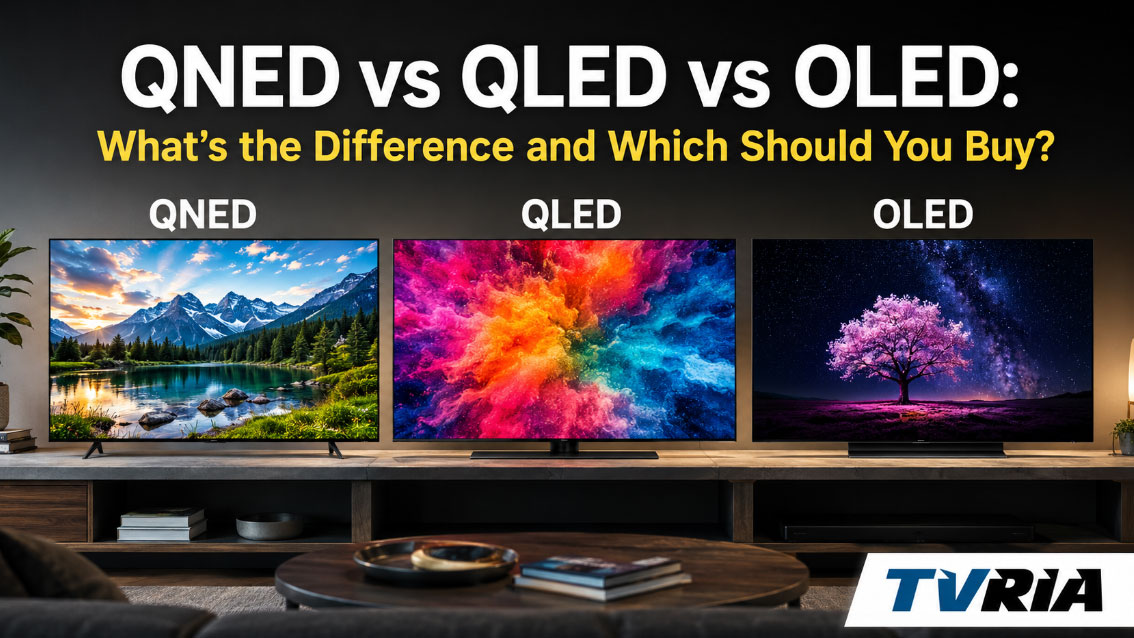
Walk into almost any electronics store in 2026 and you'll hit the same wall of confusion: rows of televisions, all playing the same demo reel of hummingbirds and coral reefs, all claiming to be the "best picture you'll ever see," and all labeled with acronyms that sound like they were dreamed up by a committee trying to confuse you on purpose. QLED. OLED. QNED. Neo QLED. QD-OLED. Mini-LED. It's genuinely a lot, and salespeople aren't always the most reliable narrators when there's a commission on the line.
Here's the good news: once you strip away the marketing language, there are really only three core technologies you need to understand — OLED, QLED, and QNED — and the differences between them are concrete, measurable, and directly tied to how a TV will look in your specific room. This guide walks you through what each one actually is, how they perform side by side, and which one deserves your money based on how and where you actually watch TV.
The Quick Answer, If You're in a Hurry
If you want the short version before the details: OLED gives you the deepest blacks, the best contrast, and the widest viewing angles, and it's the top pick for dark or dimly lit rooms and movie-first viewers. QLED (and its Mini-LED-backed sibling, Neo QLED) gets significantly brighter, holds up better in sunlit living rooms, and typically costs less for a given screen size. QNED, LG's answer to Samsung's QLED, combines Mini-LED backlighting with quantum dots and LG's NanoCell filtering, landing in the middle — brighter than standard LED sets, not quite as inky-black as OLED, and usually priced between the two.
If your room has big windows and afternoon sun, lean QLED or QNED. If you watch mostly at night with the lights low, OLED is going to reward you every single time you turn it on.
What the Letters Actually Mean
Let's get the vocabulary sorted first, because half the confusion around these TVs comes from acronyms that sound similar but describe genuinely different engineering.
OLED: Organic Light-Emitting Diode
Every single pixel in an OLED panel produces its own light and its own color. There's no separate backlight sitting behind the screen. When a scene calls for black, the pixel simply switches off completely — not dimmed, off. That's why OLED screens produce what's often called "infinite contrast": true black sitting right next to a blazing highlight, pixel by pixel, with zero light bleeding between them.
QLED: Quantum Dot LED
Despite the name, QLED is not a self-emissive technology like OLED. It's a traditional LED-backlit LCD panel with a layer of quantum dots added in front of the backlight. Those quantum dots refine the color produced by the LEDs, giving QLED sets richer, more saturated colors than older LED TVs. But the backlight is still shining constantly behind the LCD layer, which means true black is harder to achieve — the panel has to block light rather than simply not produce it.
QNED: Quantum Nano-Emitting Diode
QNED is LG's hybrid answer, and it stacks three technologies on top of each other: Mini-LED backlighting (thousands of tiny LEDs instead of a handful of large ones, allowing far more precise local dimming), quantum dots for color, and LG's own NanoCell filter layer, which is designed to clean up color purity and reduce color bleed at wide viewing angles. Combining quantum dots, LG's NanoCell filtering, and Mini LED backlighting, QNED TVs are built to deliver strong colour accuracy and peak brightness.
A Few Related Terms You'll Also See
- Neo QLED is Samsung's premium QLED tier, built specifically on Mini-LED backlighting for tighter dimming zones and higher brightness.
- QD-OLED is a hybrid that pairs an OLED's self-lit pixel structure with a quantum dot color layer instead of the traditional white-OLED-plus-color-filter approach. It's made by Samsung Display and used in sets from Samsung and Sony. Because QD-OLED panels use each individual pixel as the light source rather than relying on color filters in front of a backlight, they can push higher peak brightness without sacrificing contrast.
- Mini-LED isn't a competing display type by itself — it's a backlighting upgrade used inside both QLED and QNED sets to shrink dimming zones and cut down on the "halo" glow around bright objects on a dark background.
How They Work, Without the Marketing Fog
Think of it this way. An OLED panel is like a wall made of millions of tiny individual light bulbs, one per pixel, each capable of switching fully on, fully off, or anywhere in between. A QLED or QNED panel is more like a wall of frosted glass with a floodlight system behind it — the floodlights (the Mini-LED backlight) can dim in zones, and the frosted glass (the LCD layer plus quantum dots) shapes and colors the light that passes through.
That structural difference is the root of almost every performance difference you'll read about below. Self-emissive pixels mean OLED never has to "block" light to create black — it just doesn't make any. LCD-based panels, whether QLED or QNED, always have some light traveling through the glass, which is why even the best Mini-LED sets can show a faint glow (often called "blooming") around bright objects against a black background, especially in a dark room.
Picture Quality: Contrast, Brightness, Color, and Viewing Angles
Contrast and Black Levels
This is OLED's home turf and nobody seriously disputes it. Because each pixel turns off individually, an OLED screen delivers essentially infinite contrast. In a dark room watching a horror movie or a moody prestige drama, that difference is immediately obvious — space scenes render as true black instead of dark gray, and bright details punch through cleanly instead of swimming in a haze.
Brightness
This is where QLED and QNED strike back, and strike back hard. Peak HDR brightness on Samsung's QN90F-class Neo QLED sets lands roughly 300 to 500 nits brighter than the best OLEDs currently on the market, and in a bright living room, that gap is impossible to ignore. Sunlight pouring through a window will wash out a dimmer screen fast, and Mini-LED-backed sets are built specifically to fight through that. That said, the newest OLEDs are closing the gap faster than expected — 2026 has brought continued brightness improvements to both traditional WOLED panels and QD-OLED sets, with several higher-end models from LG, Samsung, and Sony now hitting noticeably higher peak brightness than their predecessors.
Color and Viewing Angles
Here OLED reclaims the advantage. OLED maintains superior viewing angles, holding onto accurate color and contrast even when you're seated well off to the side, while QLED and QNED panels are more prone to color shifting and dimming at wider angles — a real consideration if you regularly have people spread across a wide couch or a big room for game nights.
Gaming Performance
If your evenings involve a controller more than a remote, this matters. OLED's near-instant pixel response and famously low input lag make it the preferred choice for competitive and fast-paced gaming, while QNED's brightness advantage can actually help HDR gaming pop more in a well-lit room. Both LG's OLED and QNED lines, and Samsung's Neo QLED lineup, now ship with a full suite of next-gen gaming features — 4K at high refresh rates, variable refresh rate support, and near-instant auto low latency mode switching — so the gap between them for responsiveness has narrowed considerably compared to a few years ago.
Comparison Table: QNED vs QLED vs OLED at a Glance
| Feature | OLED | QLED (Neo QLED / Mini-LED) | QNED |
|---|---|---|---|
| Light source | Self-emissive, per-pixel | LED backlight + quantum dots | Mini-LED backlight + quantum dots + NanoCell filter |
| Black levels | True black, infinite contrast | Good with Mini-LED, some blooming | Good with Mini-LED, some blooming |
| Peak brightness | Improving, still trails top Mini-LED | Highest available, up to ~1,800–2,000+ nits on flagships | Strong, between QLED and standard LED |
| Best room type | Dark or controlled lighting | Bright rooms, sunlit living rooms | Bright to moderately lit rooms |
| Viewing angles | Excellent, minimal color shift | Narrower, more color shift off-axis | Improved over standard LED, still trails OLED |
| Burn-in risk | Small but real risk with static images | None | None |
| Typical lifespan | Roughly 30,000–100,000 hours | Comparable LCD-based durability, generally very long-lasting | Comparable LCD-based durability |
| Gaming responsiveness | Best-in-class input lag and response time | Excellent, slightly behind OLED | Excellent, slightly behind OLED |
| Starting price (55") | Roughly $1,999+ | Roughly $900–1,600 | Roughly $1,200–1,800 |
| Made primarily by | LG, Sony, Samsung (QD-OLED) | Samsung, TCL, Hisense | LG |
Prices shift constantly with sales, so treat this as a general shape rather than gospel — always check current listings before buying.
Longevity, Burn-In, and Everyday Durability
This is the question that stops a lot of shoppers cold, and it deserves an honest answer rather than a scary headline. OLED panels are organic, and organic materials degrade slightly with use. If you leave a static image — a news ticker, a video game HUD, a paused screen — on the same OLED pixels for extended periods over years, you can eventually see faint "burn-in" or image retention. It's far less common than it was a decade ago thanks to pixel-shifting, screen-savers, and better panel chemistry, but it's not zero.
QLED and QNED, being LCD-based rather than organic, simply don't have this failure mode. OLED panels typically last between 30,000 and 100,000 hours of use before meaningful brightness degradation, while LCD-based sets like QNED tend to last somewhere in the 50,000 to 60,000 hour range, and they mitigate the burn-in concern entirely. For most households, either technology will comfortably outlast the TV's usefulness before hardware failure becomes the limiting factor — but if you're the type who leaves a 24-hour news channel on in the background for years at a time, that's a legitimate reason to lean toward QLED or QNED.
Price in 2026: What You'll Actually Pay
Pricing has shifted noticeably this year, and it's worth knowing the real numbers rather than assuming OLED is always the "expensive" option and QLED is always "cheap."
On the OLED side, LG's mid-range C6 launched at $1,399 for the 42-inch model, climbing to $1,999 for 55-inch and $2,699 for 65-inch, while the flagship G6 starts considerably higher, at $2,499 for the 55-inch and $3,399 for the 65-inch. Some retailers have actually listed both models cheaper than their 2025 predecessors across nearly every size, which bucks the usual trend of TVs getting pricier year over year.
On the LCD side, Samsung's Neo QLED lineup remains the best-value ceiling-breaker: last year's QN90F, still widely available at a discount, has been found selling for around £1,299, roughly £1,200 less than a comparable LG OLED. Samsung has restructured its 2026 lineup significantly — the long-running QN90 Neo QLED series has actually been discontinued for 2026, replaced by a new R85H model that sits between Neo QLED and OLED in the hierarchy, so if you specifically want a QN90-class set, current 2025 inventory may be your best window before it disappears from shelves entirely.
QNED pricing generally lands in between, with LG positioning it as a mid-tier option beneath its OLED lineup but above standard LED sets — a genuinely useful landing spot if OLED feels like a stretch but you still want better contrast and color than an entry-level LED TV.
Which One Belongs in Your Living Room
Rather than treating this as an abstract spec battle, it helps to think about your actual room and your actual habits.
If you do most of your watching after sunset, with blinds drawn or lamps dimmed, and you care most about movie night immersion, OLED is going to reward you every time you turn the TV on. The black levels alone change how a film feels.
If your living room faces south, gets flooded with afternoon light, and you're constantly fighting glare on your current TV, a bright Neo QLED or QNED set will simply look better in that specific environment, regardless of how impressive an OLED's spec sheet reads.
If you're gaming competitively and responsiveness is your top priority, OLED's pixel-level response time still gives it a slight edge, though the gap has narrowed enough that a good Neo QLED or QNED won't hold you back.
If budget is the deciding factor and you want the biggest screen for the smallest spend, QLED generally wins on price-per-inch, especially with last year's flagship models discounted as new lineups arrive.
If you want a middle ground — better contrast and color than a basic LED set, without stretching to OLED prices — QNED is built precisely for that gap.
Real 2026 Models Worth Shortlisting
A few specific sets are worth putting on your radar this year, based on independent testing rather than spec sheets alone.
On the OLED side, LG's C6 has been called a notable step-up over its predecessor and one of 2026's best OLED TVs by reviewers, thanks largely to a faster processor shared with the flagship G6. If you want the absolute top tier, the G6 brings chart-topping brightness thanks to its new Primary RGB Tandem panel and Hyper Radiant technology, though it's also been noted for occasionally leaning oversaturated compared to last year's model.
On the LCD side, Samsung's discounted QN90F Neo QLED remains one of the strongest values available, and its 2026 flagship OLED replacement lineup, the S95H, pushes even further with a QD-OLED panel aimed at closing the brightness gap with Mini-LED entirely.
For deeper, hands-on testing before you buy, a few independent resources are worth bookmarking: RTINGS runs exhaustive lab measurements on brightness, contrast, and input lag for nearly every current model; TechRadar and Tom's Guide both publish frequent hands-on reviews and pricing trackers as new sets launch; Consumer Reports offers plain-language buying guides aimed specifically at first-time shoppers; and What Hi-Fi? tends to focus heavily on picture and sound calibration detail for anyone chasing reference-quality accuracy. For manufacturer specs and current promotions directly from the source, LG.com and Samsung.com are the most reliable starting points.
Frequently Asked Questions
Is QNED better than QLED? Not universally — they're closer than the names suggest. QNED adds LG's NanoCell filtering on top of Mini-LED and quantum dots, which can slightly improve color accuracy and viewing angles over a basic QLED, but the practical difference in day-to-day viewing is often smaller than the marketing implies. Compare specific models rather than the category names alone.
Does OLED still burn in? It can, but it's much rarer than it used to be. Modern OLED panels include pixel-shifting and automatic brightness limiting specifically to prevent it, and normal mixed viewing — streaming, sports, movies — carries very low risk. The concern is mainly for users who leave a single static image on screen for extremely long, uninterrupted stretches.
Is OLED worth the extra money over QLED? If you watch primarily in a dim or controlled-lighting room and care about contrast and black levels, yes, most people find the difference clearly noticeable. If your room is bright and you're budget-conscious, a good QLED or Neo QLED will likely satisfy you just as much for less money.
What's the difference between QNED and Neo QLED? They're each brand's version of the same basic idea — Mini-LED backlighting paired with quantum dots — just built by different manufacturers. QNED is LG's implementation, adding its NanoCell filter layer; Neo QLED is Samsung's, built around its own Mini-LED and processing pipeline. Neither is a self-emissive technology like OLED.
Which is best for a bright living room? QLED or Neo QLED, generally by a clear margin, since their higher peak brightness fights through ambient light more effectively than current OLED panels.
Which is best for gaming? OLED still edges ahead on raw response time and input lag, though the gap versus a well-specced QNED or Neo QLED gaming TV is small enough that most players won't notice a real-world difference.
The Verdict
There's no single "best" technology here, and treat anyone who tells you otherwise with a little skepticism. OLED wins on contrast, color accuracy at an angle, and gaming responsiveness, and it remains the top pick for anyone who watches mostly at night in a room they can dim. QLED and Neo QLED win on raw brightness and value, and they're the smarter buy for sunlit rooms and stretched budgets. QNED sits in between, built for shoppers who want more than a basic LED TV but aren't ready to spend OLED money.
The honest advice is to walk into a store, or at minimum watch a few side-by-side comparison videos from testers who've actually put these sets through dark scenes and bright scenes under real lighting conditions, and judge the picture with your own eyes in conditions close to your own living room. Specs on a page rarely tell you what a screen will actually feel like when you're three episodes deep into something good, lights off, on a Tuesday night.